Diagonal of Rhombus
The diagonal of a rhombus is a line segment that joins any two non-adjacent vertices of a rhombus. A rhombus has two diagonals that bisect each other at right angles, thus, they form 4 right-angled triangles which are congruent. Let us learn more about the diagonal of rhombus in this article.
What are the Diagonals of a Rhombus?
When the opposite vertices of a rhombus are joined, they form the diagonals of a rhombus. A rhombus has two diagonals that intersect each other at 90°. Observe the following rhombus to identify its diagonals and their properties listed in the following section.
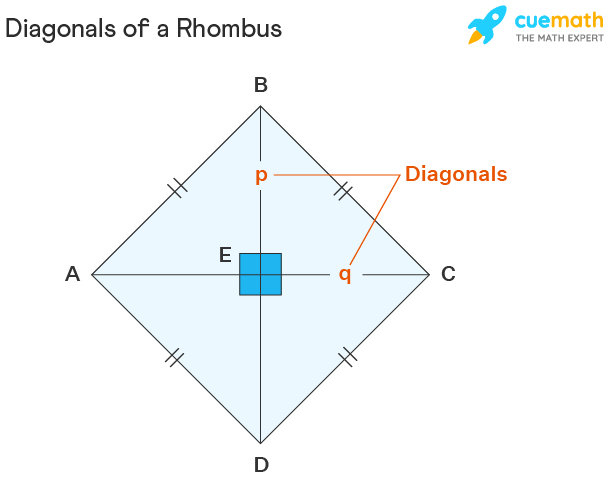
Diagonal of Rhombus Properties
The diagonals of a rhombus are line segments that are drawn between the opposite vertices of the rhombus. The properties of the diagonals of rhombus are listed below.
- The diagonals of a rhombus bisect each other at right angles.
- The diagonals of a rhombus may not be necessarily equal.
- The two diagonals divide the rhombus into four congruent right-angled triangles.
- The length of the diagonals can be calculated by various methods like using the Pythagoras theorem or by using the area of the rhombus.
Diagonal of Rhombus Formula
The formula for the diagonals of a rhombus is based on the area of the diagonals and is expressed as p = (2 × Area)/q, where 'p' and 'q' are the two diagonals of the rhombus. We know that both the diagonals bisect each other at right angles and the two diagonals divide the rhombus into four congruent right-angled triangles. Now, using these properties, let us understand how the formula to find the diagonal of a rhombus is derived.
Derivation of Diagonal of Rhombus Formula
The formula for the diagonal of a rhombus is derived using the area of the rhombus. In other words, if the area and one of the diagonals are given, then the other diagonal can be calculated using the formula, p = (2 × Area)/q, where 'p' and 'q' are the two diagonals of the rhombus. The derivation of the formula can be understood if we derive the formula for the area of a rhombus. Since we know that the diagonals of a rhombus divide it into 4 congruent right-angled triangles, the area of the rhombus will be equal to the area of all the four triangles combined together. Observe the following rhombus to see the 4 congruent right-angled triangles that can be formed in it.

Mathematically, this can be represented as,
Area of rhombus = 4 × area of one triangle
Area of rhombus = 4 × (1/2 × base × height). Now, if we take the diagonals of the rhombus to be 'p' and 'q' respectively, then the base and height in this formula can be substituted as p/2 and q/2 respectively since we know that the diagonals bisect each other.
Area of rhombus = 4 × (1/2 × p/2 × q/2)
Area of rhombus = 4 × (1/8 × p × q)
Area of rhombus = 1/2 × p × q
Now, once this formula is derived, the formula for the unknown diagonal can be derived from this. For example, if the unknown diagonal is taken to be 'p', the formula will be p = (2 × Area)/q
Important Notes on Diagonal of Rhombus
- The diagonals of rhombus bisect each other at right angles.
- The diagonals of rhombus divide the rhombus into four congruent right-angled triangles.
- A diagonal of a rhombus may not be equal to the other diagonal.

.png)
No comments:
Post a Comment